
What It Feels Like to Fly a Tricopter Drone Platform
Same controls. Different experience. Here is what to expect the first time you fly the Vulcan SX or SwitchBlade-Elite.
Most pilots expect a learning curve when they step onto a new platform. It’s one of the things we get asked about most. The Vulcan SX and the SwitchBlade-Elite don’t have a learning curve because the controls are exactly the same as what you’re already used to. But what changes is how the aircraft actually moves, and that difference tends to click fast.
Think of it like switching from a truck to a sports car. Same pedals, same wheel, same road. But one leans into a corner and the other sits flat through it. Once you feel the difference, you understand why it matters.
This is the most common comment we hear from Pilots flying the Vulcan SX for the first time, including Keegan Durfee, a 10+ year drone pilot veteran:
“It just feels like flying. When flying through turns it’s very smooth and behaves more like an airplane than a drone.”
What Makes a Tricopter Drone Design Different?
Most drones are quads, using four rotors arranged in an X or H shape. A tricopter uses three, arranged in a Y: two up front, one in the rear. That rear rotor sits on a pivot mechanism that lets it tilt left or right, and that tilt is how the aircraft turns.
On a standard quad, turning (called yaw) is controlled by spinning some rotors faster and others slower to create a rotation. It works, but the aircraft is essentially fighting itself to change direction. On the Vulcan SX and SwitchBlade-Elite, the rear rotor tilts, and the whole aircraft pivots smoothly around that input. All three rotors keep working through the turn. Nothing has to slow down or fight anything else.
That one design difference explains almost everything about how the tricopter feels in the air — the smooth turns, the stable cruise, the clean data on descent. It all starts in the same place.
From Case-open to Wheels-down: What to Expect
1. Getting Ready to Fly: Fold Out and Go
The first thing you notice when you open the Vulcan SX or SwitchBlade-Elite case is that setup doesn't waste your time. No field assembly when you start, and no reassembly when you return. Both platforms fold. To get started you unfold the arms, set the aircraft on the ground, mount the payload, click in the battery, and load the mission. One person. Under two minutes. Ready to fly.
The Y-shaped geometry packs down into a compact footprint that carries comfortably on one shoulder and into the field. It’s built for the reality that your launch site is not always next to your truck. Platforms built for field carry feel completely different from platforms that weren't — and you'll know the difference the first time you hike one in.
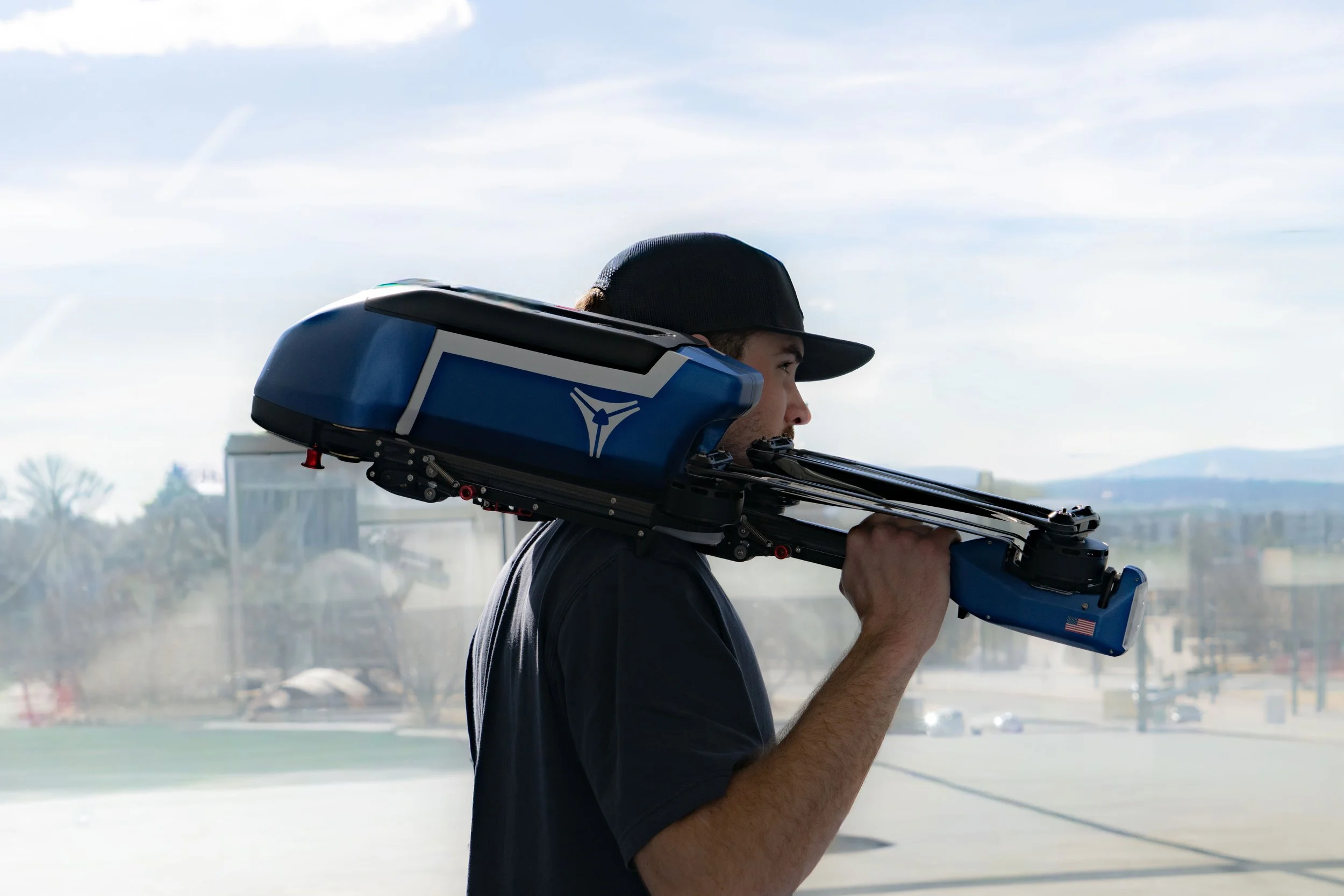
The y-shaped geometry packs down into a compact footprint that carries comfortably on one shoulder and into the field.
It’s built for the reality that your launch site is not always next to your truck. Platforms built for field carry feel completely different from platforms that weren't — and you'll know the difference the first time you hike one in.
2. Takeoff: Familiar, but Noticeably Smooth
Liftoff on the Vulcan SX and SwitchBlade-Elite feels immediately familiar. Same throttle input, same liftoff behavior. But there's a settled quality to the climb that pilots notice right away. The three rotors are spaced farther apart than on a typical quad, so each one pulls from clean air without competing with its neighbors. The result is a climb that feels planted and quiet rather than busy.
For sensor payloads, that smoothness matters from the very first meter off the ground. You are not waiting for the aircraft to settle after liftoff. It is already calm.
3. In the Air: Easy to Read, Easy to Stay Oriented
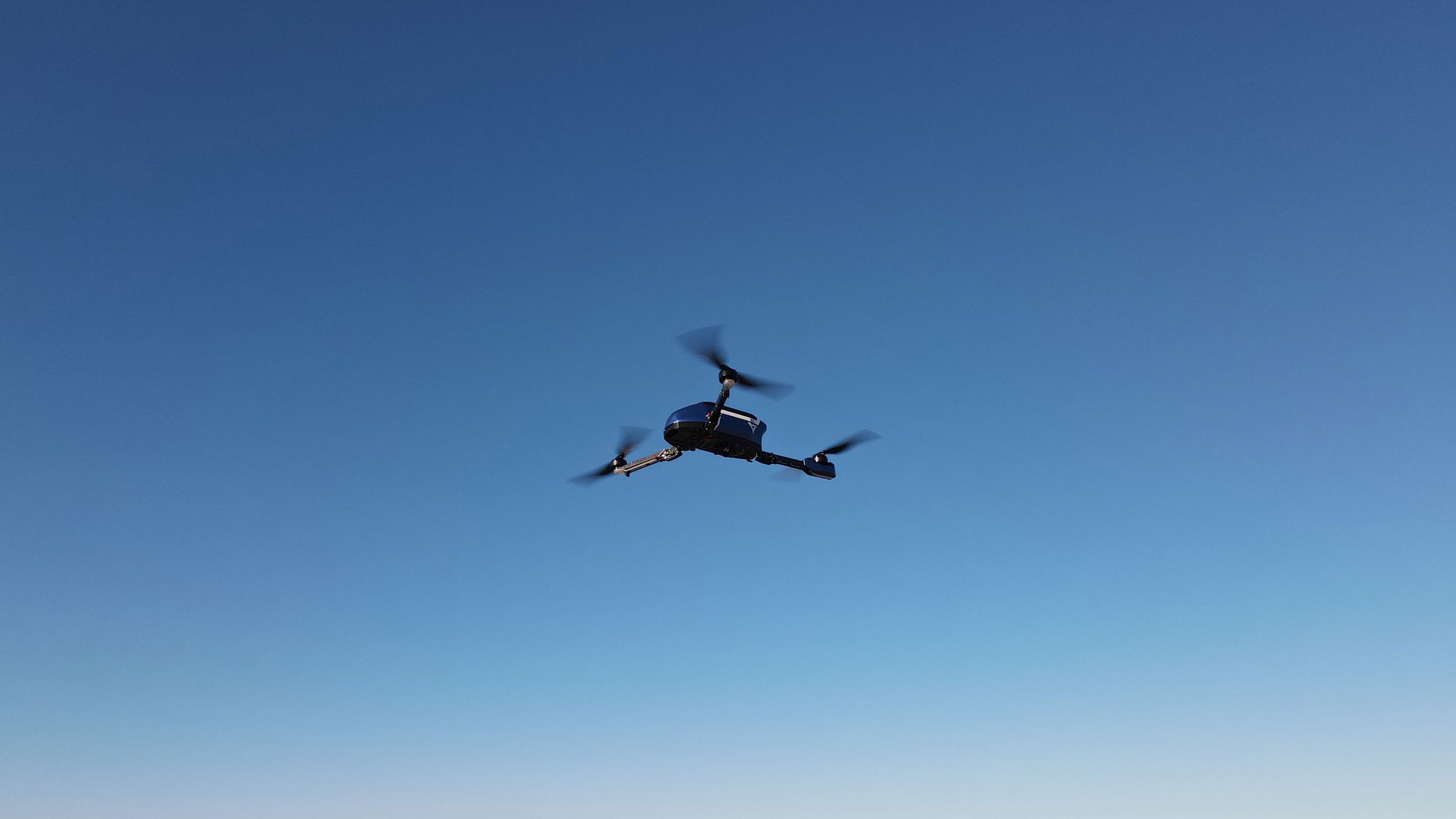
Vulcan SX is easy to read at a glance.
Once you're airborne, the Y shape of the Vulcan SX or the SwitchBlade-Elite does something a symmetrical quad can't: it tells you which way it's pointing at a glance. Even at distance, even in flat overcast light, the orientation reads instantly in a way that a symmetrical quad just does not give you.
On long inspection passes where you're watching both the drone and the asset, that clarity adds up. It reduces the low-level mental work of constantly reconfirming heading, which means you can put more attention on the mission. And all this means better decisions in the field and cleaner data at the end of the day.
4. Forward Flight: Efficient and Settled
In cruise, the tricopter's efficiency advantage is something you actually feel.The wider rotor spacing means less interference as the platform moves through the air, and the rear rotor keeps the aircraft tracking straight without the flight controller having to constantly make small corrections.
The practical result is a platform that feels like it wants to fly forward. It is not working against its own design to stay on course. Think of it like a well-balanced boat hull cutting through water cleanly versus one that is constantly correcting against its own drag. One is working. The other is just going.
For pipeline and powerline inspections, that efficiency translates directly into more ground covered per battery and fewer interruptions across a full mission day. For remote deployments where the launch site is miles from the work area, it can be the difference between a mission that works logistically and one that does not.
5. Turning: Dynamic
This is what new pilots consistently mention first, and it is the clearest expression of what makes the tricopter design feel the way it does.
Yaw is the left-right rotation of the aircraft, the turn you make when you need to change direction or orbit a structure. On the Vulcan SX and SwitchBlade-Elite, when you input a yaw, the rear rotor tilts and the aircraft leans into the turn. Not snaps. Leans. It’s the same fluid, coordinated feel you get in a manned aircraft banking through a turn, where the whole platform moves together as one unit rather than rotating through a mechanical correction.
Most pilots describe it as surprisingly smooth the first time they feel it.
That smoothness isn't just a comfort thing, it’s also a data thing. Clean turns produce better overlap consistency at the edges of your coverage area, tighter data on circuit and orbital inspection patterns, and less correction needed in in post-processing. The quality of a turn shows up in the deliverable.
6. Descent: Usable Data on the Way Down
Here is something most pilots do not know until they have flown a tricopter on a tower inspection: on most multi-rotor platforms, the data you collect on the way down is often trash.
As the aircraft descends, each rotor flies through the turbulence left by its neighbors. The platform lands fine, but the vibration in the sensor stream during descent makes that footage and sensor data too shaky to use. In practice, each pass on a vertical structure yields one direction of clean data. The ascent is clean. The descent gets thrown out.
The Vulcan SX and SwitchBlade-Elite change that. Wider rotor spacing means each rotor descends through its own clean air. In calm conditions, the descent data is clean enough to keep. This means each tower pass can effectively yield twice the usable data without a single additional flight.
For programs doing regular tower or vertical structure inspections, that’s not a minor gain. It directly reduces the number of flights needed to achieve full coverage, which cuts battery use, mission time, and the odds of sending a crew back out for a refly.
If you want to go deeper on how the tricopter design connects to overall mission efficiency and flight time, we covered that in detail in our flight time article.
What to Expect: A Quick Summary
Setup is fast.Fold out the arms, mount the payload, click in the battery, and go. Under two minutes.
Takeoff feels familiar. Same inputs you already know, with a noticeably smooth and planted climb.
Orientation is easier. The Y shape tells you which way the aircraft is pointed at a glance.
Forward flight is efficient and settled. The platform tracks straight and covers ground cleanly.
Turns feel different in the best way. Smooth and coordinated, like the aircraft is leaning into the direction change.
Descent data is usable.In calm conditions, clean data on the way up and the way down.
The transition to the tricopter design is short. Most pilots are comfortable and confident within a flight or two because the geometry is intuitive, the handling is predictable, and the platform is built to reward good piloting rather than ask pilots to work around its limitations.
Common Questions About Flying a Tricopter Drone
Is it harder to fly than a typical drone?
No. The controls are identical. The flight feel is different, and most pilots find it easy to adjust to.
Does the rear rotor pivot require special maintenance?
The rear servo on the Vulcan SX and SwitchBlade-Elite is a purpose-built industrial component. It is part of what makes the yaw system work as smoothly as it does, and it is built to hold up in real field conditions.
How does it handle wind?
Well. The rear rotor's ability to tilt gives the Vulcan SX and SwitchBlade-Elite strong wind authority. The platform can orient the rear rotor directly into the wind to push back against it in a way that fixed-rotor designs cannot match.
What kinds of missions is it best for?
The Vulcan SX and SwitchBlade-Elite are built for many industrial missions. They shine in industrial inspection and survey work: pipeline and powerline corridors, tower inspections, utility infrastructure inspections, construction monitoring, and any mission where getting clean data the first time matters. The tricopter design performs especially well on vertical structure inspections and long linear missions where cruise efficiency and descent stability have a direct operational payoff.
See It in the Field
The Vulcan SX and SwitchBlade-Elite were designed by people who’ve actually flown these missions. The tricopter drone design is not a novelty. It is an engineering approach that shows up in every second of flight from liftoff to final descent. If you want to see what that feels like firsthand, we’ll put you on the sticks.
We’re a little more bourbon & brats than champagne & caviar.
And if you’re reading this, chances are, you are too.
→ Ready to start a planning conversation? Let’s chat. ←