
Vision Aerial Unveils Vulcan Drones at Geo Week 2026: Montana-Made Power for Surveying
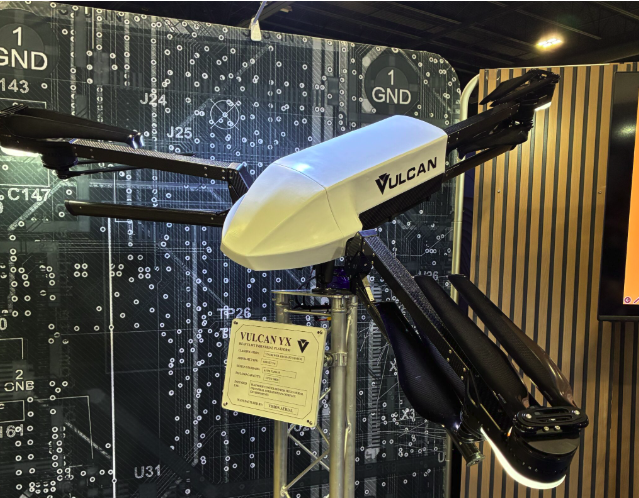
The heavy‑lift Vulcan YX was unveiled at Geo Week 2026, showcasing Vision Aerial’s Montana‑built design for demanding industrial and survey missions.
07 Mar 2026 | By Dahlia Kopycienski
Originally posted on Autonomy Global at: https://www.autonomyglobal.co/vision-aerial-unveils-vulcan-drones-at-geo-week-2026-montana-made-power-for-surveying/
See more about the Vulcan platform at Geo Week 2026.
Vision Aerial stole the spotlight at Geo Week 2026 with the launch of its Vulcan drone platforms, rugged American-made systems built for geospatial professionals. In an exclusive interview with Autonomy Global, company leaders explained how in-house Montana manufacturing and a distinctive tricopter architecture translate into reliability surveyors can trust in the field.
From Motorhome Prototype to Bozeman Powerhouse
The Vision Aerial story begins on the road. Company CTO and Founder Shane Beams built his first wooden drone prototype while traveling the country in a motorhome with his wife, having left San Diego in search of a new home base. Originally from Montana, they evaluated communities through a dual lens: where they wanted to live and where they could build a business.
Bozeman rose to the top. The city’s dramatic mountain backdrop pairs with a strong engineering pipeline from Montana State University, where many graduates choose to stay, creating a tight-knit ecosystem of talent and innovation. Shane returned to Montana and launched a Kickstarter from his garage, spending the first year building the business on his own. Founded in 2013, Vision Aerial has since grown shop by shop into a vertically integrated manufacturing operation. Geo Week 2026 marked a rare trade show outing, but surveyors fit the company’s culture, making Denver the natural launchpad for Vulcan’s debut.
Why Montana Manufacturing Matters
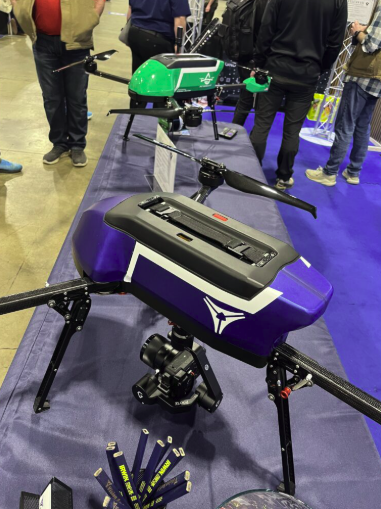
Multiple Vulcan SX aircraft configured with different payloads highlight how Vision Aerial’s tricopter platform adapts to mapping, inspection, and utility workflows.
That culture shows up on the factory floor, where machining, assembly, and testing all happen under one roof. The single-site manufacturing operation can be summed up with an internal joke: “Raw materials in one door, flying robots out the other door.” In an American drone market dominated by imported airframes and far-flung contract manufacturers, it is both unusual and refreshing to see this much design, fabrication, and final assembly concentrated in one Montana facility.
Vision Aerial keeps as much of its supply chain local to Bozeman tech and labor as possible. The team outsources only where specialists add clear value, such as carbon fiber rotors from half a dozen vendors who can produce them faster, cheaper, and more precisely. That approach avoids single points of failure and, importantly, predates recent global supply chain disruptions.
Chief Marketing Officer Susan Roberts says the team has spent the last several years deliberately pulling manufacturing and procurement of critical parts back close to home. In parallel, engineers have been building the new Vulcan platform to meet rigorous standards, with process documentation to prove they can do what they say they do.
The result is a fleet of durable drones that fold compactly, ride easily over a shoulder in rugged cases, and rely on hot-swappable batteries so crews can land, change packs, and relaunch in minutes. Those design choices matter as much as any spec sheet for surveyors who cannot afford downtime.
Vulcan Platform: Built for Real-World Missions
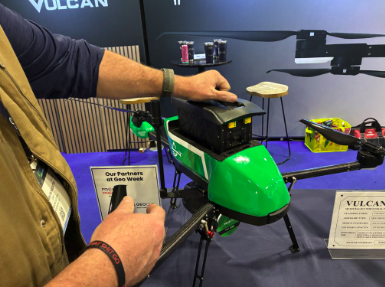
A Vision Aerial team member demonstrates hot‑swappable batteries on the medium‑lift Vulcan SX, enabling rapid turnarounds for survey crews in the field.
At Geo Week, Vision Aerial formally introduced the Vulcan line, an evolution of its original SwitchBlade-Elites with new capabilities such as terrain following and collision avoidance. The Vulcan platform currently includes two aircraft built on a shared architecture: a medium-lift model, SX, now in production and a heavy-lift variant, YX, available for preorder.
The medium-lift Vulcan SX carries up to 3 kilograms of payload for about an hour in testing, with real-world flights at Bozeman’s elevation typically running 40–45 minutes. Operators can expect even better performance at sea level, according to Roberts. The Vulcan SX tricopter configuration, featuring three arms and three rotors, improves efficiency compared with conventional quadcopters in the same class. Adding payload to the SX configuration does not cut down endurance the way many users have come to expect.
For heavier jobs, the Vulcan YX variant uses six motors on a Y-shaped frame to deliver more lift, up to 10kg, while retaining the same basic design language. Across both airframes, Vision Aerial supports roughly a dozen payloads, including energy sensors for utility inspections, methane detection packages, and systems configured for surveying, construction progress monitoring, and powerline or infrastructure scans.
Designing to ASTM F3298-19 From Day One
Underneath the hardware, the Vulcan platform reflects a deliberate certification strategy. Vision Aerial engineers pursued ASTM F3298-19 early and built the new platform around its requirements from the start.
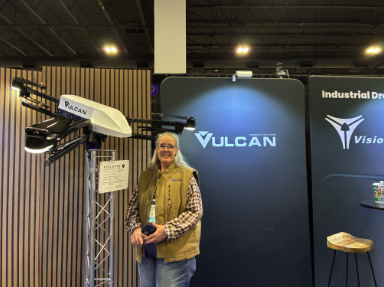
Chief Marketing Officer Susan Roberts stands beside the Vulcan YX at Geo Week 2026, where Vision Aerial debuted its industrial drone platform.
ASTM F3298-19 lays out baseline criteria for how a light UAS is designed, built, and tested, covering the aircraft, its payloads, the ground control station, launch and recovery equipment, and command-and-control links, along with requirements for performance, structural loads, propulsion limits, equipment installation, documentation, and verification. Agencies such as the U.S. Forest Service already use F3298-19 as a selection benchmark for UAS under about 80 pounds, so compliance has a direct bearing on procurement and operational approvals.
For Vision Aerial, aligning with this standard means every major design decision, test campaign, and production process ties back to a recognized airworthiness framework instead of shop folklore. This positions the Vulcan platform for faster acceptance when regulators or enterprise customers ask for evidence to support higher-risk missions. Achieving that level of rigor while building American-made drones in Montana gives the company a rare combination of compliance, local manufacturing, and field-ready reliability.
A Geospatial Launchpad at Geo Week
If Bozeman shapes the company’s engineering culture, Geo Week shaped its latest commercial move. Beams sees surveyors as “right in the bailiwick” of Vision Aerial’s customer base with the engineers who build Vulcan spending their days around the same “salty & smart” surveyors they serve. The Vulcan platform is tuned to real survey workflows, so Geo Week 2026 was the natural place to launch it.Unsurprisingly, surveyors packed Vision Aerial’s booth in Denver to examine Vulcan’s survey-ready features in person, from stable tracking and high-resolution imaging to modular payload options tailored for mapping and inspection workflows. With medium-lift Vulcan SX units already in production and heavy-lift Vulcan YX systems on preorder, the company now invites surveyors, inspectors, and utilities to put its Montana-made platforms to work.
Full specifications, preorder information, and press materials are available at visionaerial.com.