
Why the Tri: Why Vision Aerial Uses Tricopter Drones for Industrial Inspection and Survey Work
There is a question we get all the time.
"Why three?"
At trade shows, on demo days, in the middle of a field briefing when someone walks over and tilts their head at the aircraft sitting on the ground. At Vision Aerial, we design industrial drone platforms for demanding field operations. One of the defining characteristics is our tricopter drone, a three-rotor architecture design that improves efficiency, sensor stability, and endurance for inspection and survey missions.
We love this question. Not because it gives us a chance to pitch something, but because it is actually a good question that deserves a real answer. And the real answer is not a bullet point on a slide or a spec comparison table. It is a story about how we think, what we have learned, and what we believe industrial drone work actually demands.
It Started With the Mission
Vision Aerial was not founded just to build a drone. It was founded to solve a problem.
Industrial field operations, the hard work at gas pipelines, communication towers, and wildfire fronts, needed a tool built from the ground up for those environments, not adapted from something else. Not marketed toward them.Actually designed for them, from the ground up, with the realities of that work at the center of every decision.
That meant starting with a question most drone manufacturers do not ask first: what does the field actually demand?
Not what is easiest to manufacture. Not what looks most familiar on a product page. But rather what does a crew in the field, on a real mission, in real conditions, actually need from the aircraft they are flying?
When you start there and stay honest with yourself through the whole design process, you make different choices at every step. The tricopter is the sum of those choices.
Different Missions Require Different Aircraft
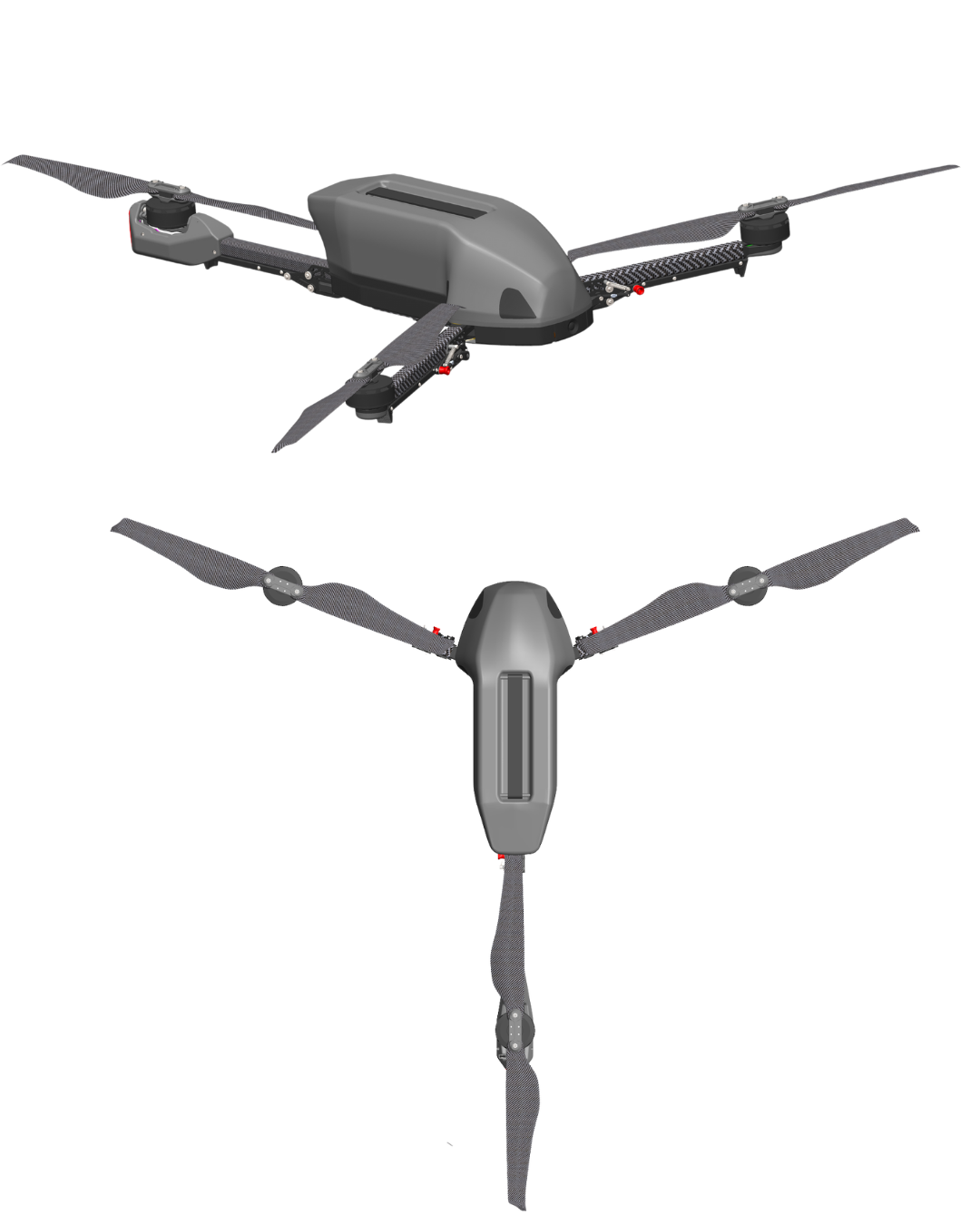
Vulcan SX Tricopter Design
There's a common assumption that fewer rotors means a simpler solution. It's an understandable one, but the reality is more nuanced than it first appears.
We chose three rotors because when we worked through what the mission needed, three kept coming out ahead. Not just in one area, all across the board.
The aerodynamics of a three-rotor configuration, when done correctly, produce better cruise efficiency than four rotors at the same thrust. That efficiency translates directly into flight time, and flight time in industrial operations is not an abstract metric. It determines whether a crew can complete a corridor in a single flight, whether a team can reach a remote site without staging additional batteries miles from the launch point, and the scope of what is possible on any given day.
This philosophy is what shaped the SwitchBlade-Elite and our Vulcan SX platform. Both aircraft use the tricopter architecture because it provides the endurance, airflow characteristics, and sensor stability that demanding inspection and mapping missions require.
The tricopter architecture is ideal for many industrial missions where efficiency, sensor stability, and long flight times are critical.
But aircraft design is always about mission requirements. Some missions demand something different.
That’s why Vision Aerial also developed the Vulcan YX, a heavy-lift hexacopter designed for large payloads and specialized sensor packages. While it uses six rotors to achieve greater lift capacity, the aircraft still follows the same three-arm geometry that defines our tricopter design philosophy. Different missions require different tools, and our platform lineup reflects that reality.
The design is not theoretical. It is the architecture behind the aircraft currently flying pipeline inspections, LiDAR surveys, wildfire mapping, and industrial inspections around the world. And it’s the design that we have intentionally carried forward to our new Vulcan line of industrial drone platforms.
We did not choose three because it was convenient. We chose three because it worked out in favor of the mission, and the mission is the most important thing.
What Happens Above the Sensor
One of the things that took time to appreciate fully was how much the airframe geometry affects the data collected below it.
Precision sensors, LiDAR systems, thermal cameras, multispectral arrays, and gas detection payloads are not forgiving instruments. They are designed to operate within tight tolerances. Vibration, turbulence, and inconsistent airflow around the sensor affect the quality of the data in ways that are not always obvious during the flight but show up clearly in post-processing.
The way rotors interact with each other during flight creates turbulent air. During vertical movement, particularly on descent, this turbulence moves through the airframe and into the sensor environment. For a camera taking photos, such as in survey and mapping, the effects are cosmetic. For a LiDAR system building a centimeter-accurate point cloud, or a thermal sensor mapping temperature variation across an asset, those effects matter.
The three-rotor configuration spaces the rotors more widely. Because there’s more space, each rotor draws from cleaner, less turbulent air than a quad would encounter. The sensor environment beneath the aircraft is calmer and more consistent.
The data that comes back reflects the precision the instrument is capable of, rather than being limited by the platform carrying it.
This is something operators discover nearly immediately. The first sign is usually a point cloud that comes back cleaner than expected, or a thermal dataset that delivers consistently across a vertical inspection run. It is not magic. It is a thoughtful design.
For vertical inspections specifically, towers, facades, tank farms, and utility structures, the smooth airflow during descent means the aircraft can collect usable data on the way down as well as on the way up. That changes how you plan a mission and how long it takes to achieve full coverage of a complex target in nearly half the time.
This sensor-first design philosophy is why Vision Aerial platforms regularly fly demanding payloads such as LiDAR scanners, thermal cameras, multispectral sensors, and optical gas imaging systems used for methane detection.
We’re a little more bourbon & brats than champagne & caviar.
And if you’re reading this, chances are, you are too.
→ Ready to start a planning conversation? Let’s chat. ←
The Sensor Is the Point
Most platforms treat the payload as something added after the airframe is finished. That is not how Vision Aerial tricopters are built.
The integration between airframe and payload has been a first-order design consideration from the beginning. Mounting geometry, vibration isolation, power delivery, thermal environment, and weight distribution: all of it was developed around the sensors the platform would carry. When a LiDAR system, thermal sensor, or multispectral camera is installed, it operates in an environment the airframe was designed to provide. Not one that payload has to compensate for.
Operators running demanding data workflows have recognized the difference. When the deliverable is a precision product that drives real decisions about infrastructure, resource management, or public safety, the data holds together differently when the platform was built to support it.
Designed for the Places Where Work Happens
Industrial drone operations share a characteristic that is easy to overlook from the outside: they are almost never conducted in convenient locations.
Pipelines run through roadless terrain. Communication towers sit on ridgelines. Wildfire mapping operations move fast through unpredictable environments. The sites where the data is needed most are often the hardest places to get to, set up in, and operate from.
This shaped how we thought about the physical design of the platform. Not as an afterthought, but as a core design consideration alongside aerodynamics and sensor integration.
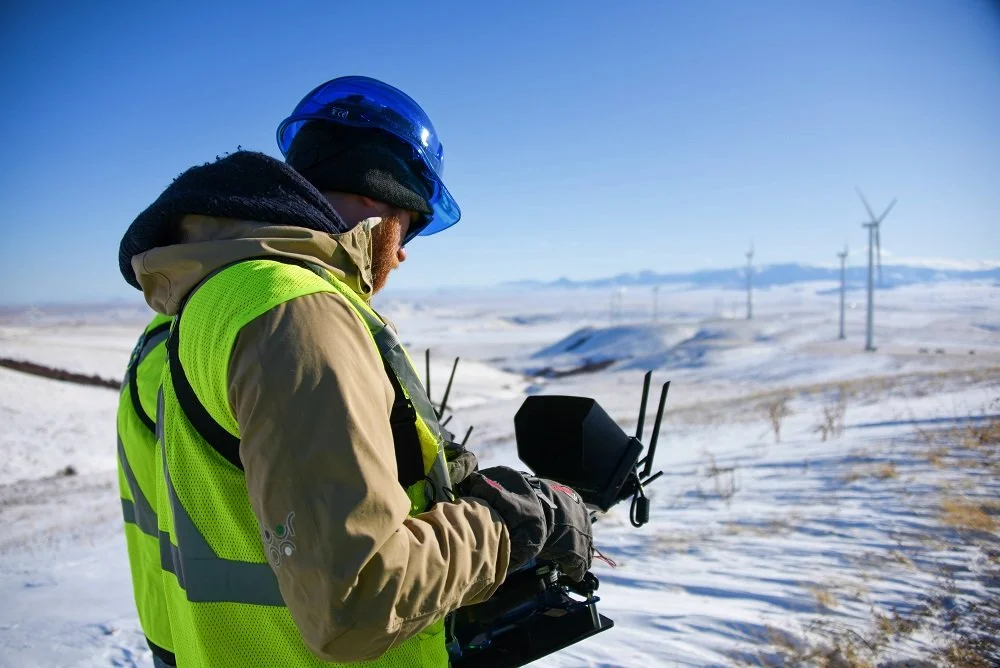
Industrial Mission Profiles
The Y-shaped arm configuration folds in a way that packs naturally, so you aren’t fully reconstructing a drone in the field. The geometry eliminates dead space inside the case without adding bulk to your truck bed. When a crew is moving gear overland to a remote launch point, or sorting through a kit at 5 AM in a staging area, the way everything fits together is not a trivial detail.
Setup is another area where the design reflects field experience rather than lab assumptions. Fewer mechanical connection points mean a 2-minute case to deployment speed. On time-sensitive missions, such as wildfire response or emergency infrastructure assessment, that timeline is part of the operational equation. But it’s equally as important if you’re inspecting miles of pipelines or you’re traveling to multiple sites in a day.
None of this happened because simplicity was the goal. It happened because the people building this aircraft had spent time in those environments and understood what the work actually felt like on the ground.
Flight Characteristics of a Tricopter
There is something that experienced pilots notice when they first get time on a Vision Aerial tricopter, but it usually takes a few flights before they can articulate it.
The aircraft reads well in the air.
The Y shape creates an unambiguous visual reference for heading that holds up at range and in conditions where orientation becomes challenging. The asymmetric design keeps the aircraft easy to spot even against bright skies, cluttered industrial backgrounds, and featureless terrain.
Orientation loss is one of the most common sources of pilot error in manual flight. It is not a beginner problem, although it affects beginners most acutely. It happens to experienced operators in the specific conditions where industrial missions tend to operate: at range, in variable light, and in environments that do not offer the visual cues a pilot would have in a controlled setting.
For programs running multiple pilots at different experience levels, or standing up crews in field offices where the training pipeline needs to be efficient, this translates into something concrete. Pilots get oriented faster and stay oriented longer. The cognitive bandwidth that would otherwise go toward "which way am I pointing" goes towards the data collection instead.
A Different Way to Think About Reliability
The reliability conversation in the industrial drone platform industry tends to revolve around motor count. The reasoning is intuitive: more motors, more redundancy, more safety margin.
It is not a bad instinct. But it is an incomplete one.
The reliability of a system is not determined by the count of any single component type. It is determined by the quality of every component, the conditions each one operates under, the integration discipline of the system as a whole, and the cumulative probability of failure across all of the above.
A three-rotor system has fewer total drive components. Fewer drive components means fewer failure points in the system. It also means that the same engineering and component budget can be concentrated across fewer motors, which changes the quality-per-axis equation. Three high-quality motors will out perform 4 midgrade motors significantly.
We are not making a theoretical argument here. The SwitchBlade-Elite has flown over a decade’s worth of hours across wildfire response, infrastructure inspection, public safety missions, and many others. In conditions that stress test every assumption in the design. The reliability picture that has emerged from that record is what you would expect from a system built with this level of engineering discipline applied to a reduced set of well-chosen components.
That reliability record is why the tricopter architecture continues in our current aircraft lineup. Platforms like the SwitchBlade-Elite and Vulcan SX build on that decade of operational experience in public safety, infrastructure inspection, and industrial survey missions.
Wind and the Field Reality
One of the quieter strengths of the Vulcan SX and SwitchBlade-Elite is how they perform in wind.
Industrial missions do not wait for calm days. The work happens when the work needs to happen, and weather is a variable that field teams learn to operate within rather than around. Pipelines, towers, search and rescue, and wildfire perimeters do not reschedule.
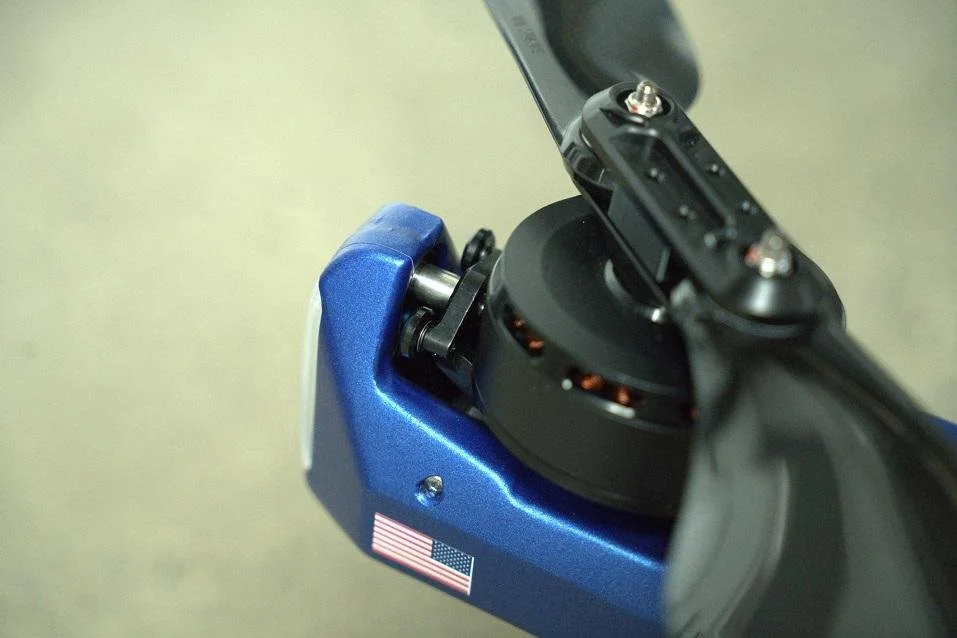
Rear Yaw Mechanism
The tilting rear rotor that gives the tricopter its yaw control also gives it a wind response characteristic that pilots who have spent time in the aircraft describe as planted. In crosswind conditions such as ridgelines, coastal sites, and open industrial terrain, the aircraft holds steady with precision that translates directly into consistent sensor coverage.
Position stability under wind load is not just for visual comfort. It is a data quality variable. An aircraft that is working harder to hold position is an aircraft that is moving during data collection. That movement shows up in the data.
Teams operating the SwitchBlade-Elite and Vulcan SX have consistently been able to fly in rough conditions. Not because the tricopter is invulnerable to wind, but because the design gives it genuine authority in conditions where authority matters. That operational window matters to clients who need the data regardless of what the forecast looks like.
The Real Cost of Running a Program
The number on the purchase order is the one that gets attention in a budget conversation. It is almost never the most important number in a program analysis.
Industrial drone programs are multi-year investments. The platforms, the training programs, the re-fly rate when data does not come back clean the first time: all of these are part of what a program actually costs over its operational life.
The efficiency of the tricopter drone design affects several of these in ways that compound over time. Longer flight times mean fewer battery cycles per mission hour. Fewer cycles extend battery service life and reduce replacement frequency. Better first-pass data quality reduces the re-fly rate, which is one of the more expensive outcomes in a drone program.
None of these are in isolation. Together, across a year of operations, they tell a different story about total program cost than the acquisition price alone does.
The metric that tells the honest story is longevity. Vision Aerial tricopters are modular by design, built to be updated and expanded as sensor technology and mission requirements evolve. There are platforms in the field that have been flying for nearly a decade with simple upgrades. Not retired. Still working. That kind of operational lifespan is what serious program managers are looking for, and it is where the design discipline built into these platforms shows up most clearly over time.
Who We Are in This Industry
Vision Aerial was founded in 2013 with a straightforward mission: building robotics to benefit humanity. Everything about Vision Aerial operates from that, who we build for, how we build, and what we think the relationship between a manufacturer and the people flying the aircraft should look like.
From the beginning, our focus has been on operators doing real work in difficult conditions — public safety teams, infrastructure inspection contractors, environmental monitoring organizations, precision agriculture operators, survey professionals. People who are serious about their work and need a platform and a company they can actually rely on.
That reliance shows up in the small things as much as the large ones. When an operator calls us with a field question, they get a real answer from someone who understands what the problem actually is. When a mission profile is unusual or a payload integration presents a new challenge, that conversation happens between people who have been in the field. When something does not work the way it should, it gets addressed.
The knowledge that accumulates over more than a decade in this industry, about how to run effective programs, integrate demanding payloads, navigate regulatory environments, and build teams that produce consistently good work in difficult conditions, does not just show up in our product specifications. It gets passed along through real conversations between our users who are trying to do serious work and are willing to share what they have figured out.
That is the community Vision Aerial has been part of for over 13 years, and the one we remain committed to.
So Why the Tri
The answer, after all of it, is that the tricopter drone design is what happens when you stay honest about what the work demands and refuse to compromise on that.
The efficiency came from the design of the three-rotor configuration and the determination to build a high-quality system. The data quality came from understanding the relationship between airframe geometry and sensor performance and treating that relationship as a design requirement rather than a side effect. The field ergonomics came from the accumulated experience of experienced pilots who have carried equipment to remote sites and know what that actually feels like. The reliability came from engineering discipline applied to a reduced set of high-quality components, running well over many thousands of flight hours.
The design is different, it has always been different. That has never been the point or the problem.
The point is that every choice in the design traces back to something real: a field condition, a data requirement, a mission profile, an operational constraint that the people building the aircraft had actually encountered and decided to solve for.
That is what the Vision Aerial tricopter is. It is the accumulated answer to the question we have been asking from the beginning: What does the mission actually need?
That principle is what shaped the SwitchBlade-Elite, and it is why we continued the tricopter architecture in the Vulcan SX. The design is not a one-off idea. It is a philosophy that has proven itself in the field and continues to guide how we build aircraft for the work ahead.
We’re a little more bourbon & brats than champagne & caviar.
And if you’re reading this, chances are, you are too.
→ Ready to start a planning conversation? Let’s chat. ←